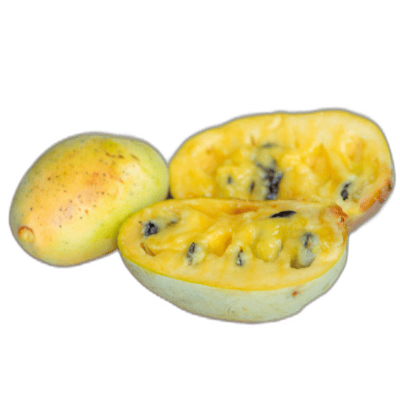
Indian banana-Paw-paw
Taste: very sweet, creamy, notes of mango and banana
How to eat: cut and eat the pulp with a spoon
Ripeness: yellow-green skin, soft to the touch
Storage: refrigerator for 5 days
BOTANY
Asimina is a deciduous tree of the northern temperate zone. It is from the apple family Annonaceae, and its origin is North America. Paw-paw is interesting as a unique and unusual fruit tree with a pyramidal shape and a straight trunk with lush dark-green hanging leaves, which turn golden-brown in autumn. Annual plants need to be well watered and kept in partial shade, which accelerates growth. After that, growth accelerates and the trees usually need more sun, and in five to seven years they grow 2-3 meters in height.
SOIL AND CULTIVATION
Paw-paw grows best on fertile, well-drained and acidic (pH 5.5-7.0) soil. As a rule, heavy, wet and alkaline soils should be avoided. When planting fruit trees, the recommended distance between trees is 3 m, and between rows 2 m. The direction of the rows is north-south. Two-year-old trees that are 1 m tall can have as many as 40 flower buds. The plant flowers in April, and the flowers are colored and appear singly and can reach up to 5 cm in diameter. Natural pollinators are various insects and flies, and it can also be pollinated manually with brushes. The fruits ripen from September to October and weigh 50-500g, and are 7-15 cm in size.
FERTILIZATION AND PESTS
In its native habitat, the pest is the Talponia plummeriana moth, which causes the flower to wither, the larva of the Eurytides Boleyn butterfly, the Zebra swallowtail caterpillar, feeds on the leaves, and the surface of the fruit can be covered with black spots caused by a fungal infection. The high level of natural compounds in the tree makes it very resistant to insects and other pests that are not found in our region. Fertilization can be done in the spring in the form of granular fertilizers, and once a month in May, June and July and during the active growth phase, top dressing with water-soluble fertilizer 20N-20P-20K. Italpollina’s organic fertilizers such as Vulcano and Fulet have shown great results.
HERBAL AND FRUIT MEDICINAL PROPERTIES
Paw Paw is an excellent source of food. The fruit is best eaten fresh when fully ripe, and then it has a tropical, sweet, juicy taste, and a fruity and floral aroma. The flavor of the fruit is a creamy mixture of banana, mango, avocado and pineapple. The fruit has the potential to be sold fresh, as an extract for baby food, in dairy products such as yogurt and ice cream flavoring, and as a dietary supplement. The skin of the fruit is hard, green, and turns yellow and red when ripe. When the fruit is cut open, the inside is a soft, sweet, white-yellow flesh, containing enzymes, bioflavonoids, rich in minerals such as chromium, potassium, magnesium, as well as vitamins A, C, B, amino acids, calcium and iron, and has a high energy value. Inside the fruit are two rows of brown seeds that are up to 3 cm long. The seeds contain an alkaloid that is an emetic. If the seeds are chewed, they affect the digestion of mammals, but if they are swallowed whole, they simply pass through the digestive tract. The leaves and twigs contain an active substance called annonaceous acetogenins-asimicin, which is an anticancer substance and is used to produce anticancer drugs and natural (botanical) pesticides.
CULINARY AND STORAGE
When the fruits are fully ripe, they can be kept at room temperature for about five days, while in the refrigerator they can be kept for about ten days. If the fruits are not fully ripe, they can be kept in the refrigerator for about three weeks and then ripen at room temperature for a few days. The primary purpose of the fruit is to be consumed fresh. It can be used as an additive in various sweet desserts and recipes with little heat, i.e. cooking or baking (fruit drinks, ice cream, fruit salad).
Nutritional Comparison of Pawpaw and Other Fruits:
Composition Units Pawpaw Banana Apple Orange
Energy Calories 80 92 59 47
Protein grams 1.2 1.03 0.19 0.94
Total fat grams 1.2 0.48 0.36 0.12
Carbohydrates grams 18.8 23.4 15.25 11.75
Dietary fiber grams 2.6 2.4 2.7 2.4
Vitamins
Vitamin C milligrams 18.3 9.1 5.7 53.2
Thiamine milligrams 0.01 0.045 0.017 0.087
Riboflavin milligrams 0.09 0.1 0.014 0.04
Niacin milligrams 1.1 0.54 0.077 0.282
Minerals
Potassium milligrams 345 396 115 181
Calcium milligrams 63 6 7 40
Phosphorus milligrams 47 20 7 14
Magnesium milligrams 113 29 5 10
Iron milligrams 7 0.31 0.18 0.1
Zinc milligrams 0.9 0.16 0.04 0.07
Copper milligrams 0.5 0.104 0.041 0.045
Manganese milligrams 2.6 0.152 0.045 0.025
Essential amino acids
Histidine milligrams 21 81 3 18
Isoleucine milligrams 70 33 8 25
Leucine milligrams 81 71 12 23
Lysine milligrams 60 48 12 47
Methionine milligrams 15 11 2 20
Cystine milligrams 4 17 3 10
Phenylalanine milligrams 51 38 5 31
Tyrosine milligrams 25 24 4 16
Threonine milligrams 46 34 7 15
Tryptophan milligrams 9 12 2 9
Valine milligrams 58 47 9 40